


Getting views on YouTube is good. Getting subscribers is even better. But if you run a gym, fitness studio, personal training business, or online coaching business, there is a more important question: is your YouTube channel actually generating business results?
That’s where YouTube ROI for Fitness Business becomes important.
A video can get 10,000 views and generate almost no customers. Another video might get 500 views but bring several qualified enquiries from people who are genuinely interested in your service.
For a fitness business, the goal isn’t simply more views. It’s turning relevant viewers into website visitors, leads, customers, and revenue.
This guide explains how to measure that journey and calculate the real business value of your YouTube channel.

What Does YouTube ROI Mean for a Fitness Business?
YouTube ROI measures the return your business receives from the money, time, and resources invested in your channel.
The basic formula is:
YouTube ROI = (Revenue − Total Investment) ÷ Total Investment × 100
For example, if you invest A$600 into YouTube content and generate A$3,000 in attributable revenue:
(A$3,000 − A$600) ÷ A$600 × 100 = 400% ROI
But the difficult part isn’t the formula.
You need to know:
- How much YouTube actually cost
- How many leads came from YouTube
- How many leads became customers
- How much revenue those customers generated
- Whether YouTube influenced customers before they converted through another channel
That’s why you need to connect YouTube Analytics with your website and customer data.
Why Views and Subscribers Aren’t Enough
Views, subscribers, likes and watch time are useful performance indicators, but they don’t automatically represent business revenue.
Imagine two local gyms.
Gym A
- 20,000 views
- 1,500 subscribers
- 10 enquiries
- 2 new members
Gym B
- 2,500 views
- 200 subscribers
- 15 enquiries
- 5 new members
If you’re measuring audience growth, Gym A looks stronger.
If you’re measuring customer acquisition, Gym B may have created more valuable business opportunities.
This is especially important for local fitness businesses. You don’t necessarily need a huge audience. You need the right audience.
YouTube Studio provides reports covering impressions, CTR, views, watch time, audience behavior and traffic sources. YouTube Analytics
For example, YouTube Search can reveal what people are searching for when they discover your content.
That information can help you understand whether your videos are reaching people with genuine fitness-related intent.
The YouTube ROI Funnel for a Fitness Business
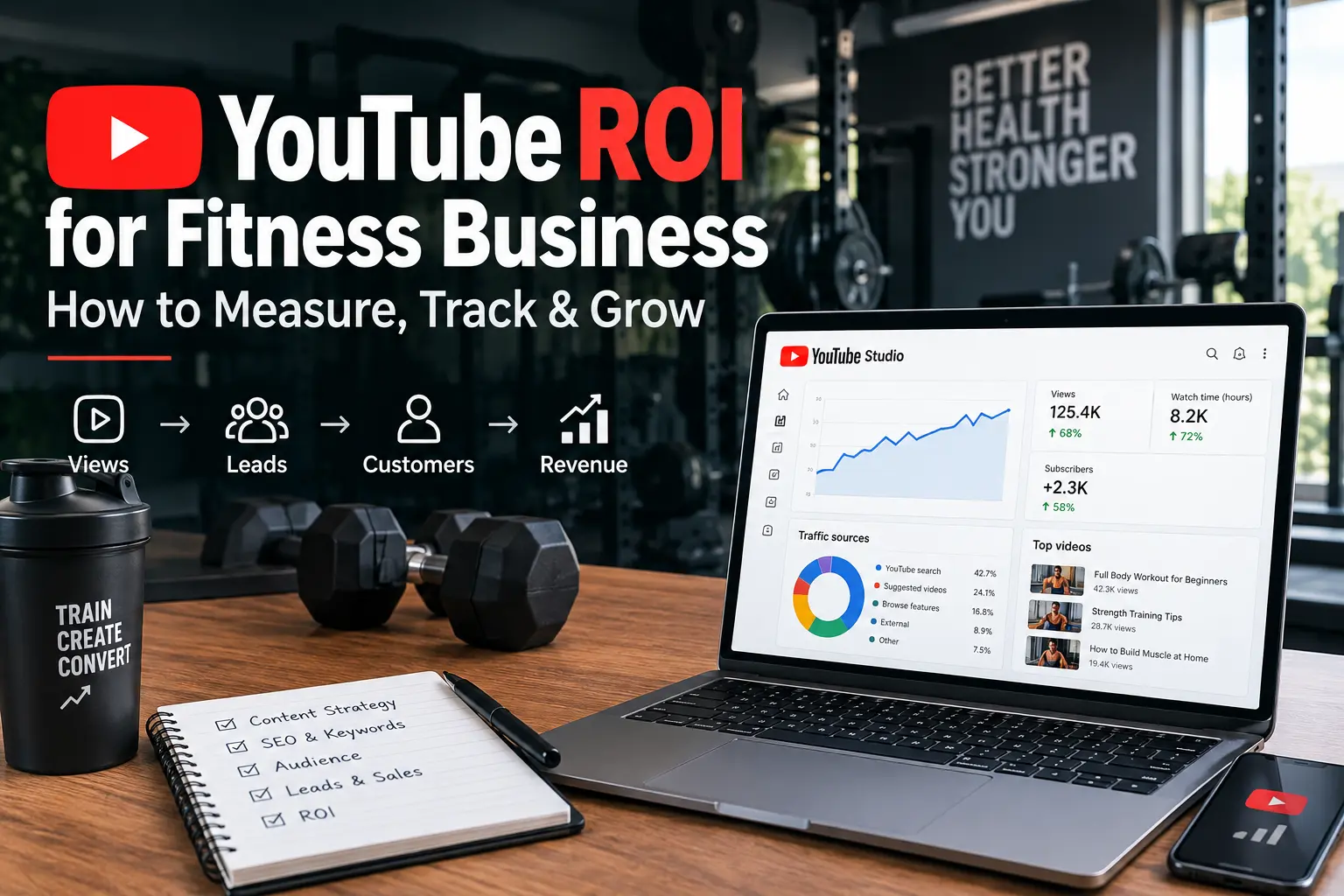
Think about your YouTube channel as part of a customer acquisition funnel:
Viewer → Website Visitor → Lead → Qualified Lead → Trial/Consultation → Customer → Revenue
For example, an Australian gym publishes:
“5 Beginner Exercises for Building Strength”
A local viewer finds the video through YouTube Search.
They watch it, visit the gym’s website, submit an enquiry and book a trial.
After the trial, they purchase a membership.
The YouTube view was only the beginning.
The business value came from what happened afterwards.
This is why generate qualified leads from YouTube is a useful next step when analysing your channel’s lead-generation process.
What Should You Count as Your YouTube Investment?
Your investment isn’t necessarily just the amount you pay a video editor.
Consider:
Production costs
- Filming
- Video editing
- Thumbnail design
- Equipment
- Freelancers or agencies
Marketing and tools
You may also use:
- SEO tools
- Editing software
- Design tools
- Analytics tools
- Paid promotion
Your time
Don’t forget the hours you spend planning, filming, reviewing, uploading and promoting content.
For example:
- Planning: 1 hour
- Filming: 1 hour
- Editing/review: 1 hour
- Uploading/promotion: 30 minutes
That’s 3.5 hours.
If you value that time at A$50 per hour, your time represents A$175 of investment.
The goal isn’t to create a perfect accounting system. It’s to avoid significantly underestimating what YouTube actually costs your business.
Which YouTube Metrics Should You Track?
You don’t need to monitor every metric in YouTube Studio.
Focus on metrics that help answer business questions.
Reach and traffic
Look at:
- Views
- Impressions
- CTR
- YouTube Search traffic
- External traffic
- Audience geography
YouTube’s official Analytics documentation explains that impressions and CTR should be interpreted together and in the context of traffic sources and audience behavior. YouTube impressions and CTR guidance .
Track:
- Watch time
- Average view duration
- Audience retention
These metrics help you understand whether viewers are actually consuming your content.
For example:
High impressions + low CTR:
Your title or thumbnail may need improvement.
Good CTR + poor retention:
The video may not be delivering what the viewer expected.
Good retention + little website traffic:
Your CTA or offer may need improvement.
If you’re trying to improve these metrics, the YouTube metrics fitness businesses should actually track can provide a deeper measurement framework.
How to Track Leads From YouTube
Once someone leaves YouTube and visits your website, you need a way to identify that traffic.
Use UTM parameters.
You can add UTM parameters such as:
utm_sourceutm_mediumutm_campaign
Google Analytics uses these parameters to identify traffic sources and campaigns. UTM campaign tracking guidance
For example, a YouTube link could identify:
Source: YouTube
Medium: Organic Video
Campaign: Free Trial
This makes it easier to understand which campaigns are sending visitors to your website.
Use a dedicated landing page
You could send viewers to a page such as:
yourgym.com.au/youtube-trial
Include:
- Your offer
- Benefits
- Testimonials
- Location
- Trial booking form
- Contact information
Ask new customers
Don’t rely entirely on analytics.
Ask:
“How did you first hear about us?”
If someone says they discovered your gym through YouTube, record it.
This can reveal customer journeys that aren’t obvious in your analytics data.
If you need help improving your channel’s search visibility and attracting more relevant viewers, you can also explore my YouTube SEO Services.
How to Calculate Your Real YouTube ROI
Suppose an Australian fitness business invests:
| Investment | Cost |
|---|---|
| Video production | A$300 |
| Editing | A$150 |
| Design/tools | A$50 |
| Owner/staff time | A$100 |
| Total | A$600 |
During the measurement period, YouTube generates:
- 15 enquiries
- 6 trials
- 3 new members
- A$3,600 attributable revenue
The ROI is:
(A$3,600 − A$600) ÷ A$600 × 100 = 500%
You can also calculate:
Cost per lead = A$600 ÷ 15 = A$40
Cost per customer = A$600 ÷ 3 = A$200
These numbers give you a much clearer picture of performance than views alone.
The example above is for illustration only. Actual results will depend on your audience, offer, sales process, retention and costs.
Don’t Ignore Customer Lifetime Value
A gym customer may be worth much more than their first payment.
For example, if a member pays A$60 per week and stays for one year:
A$60 × 52 = A$3,120 in revenue
That’s revenue, not profit, and actual customer value depends on retention and operating costs.
But it shows why measuring only the first transaction can underestimate the value of customer acquisition.
Compare your customer acquisition cost with your customer lifetime value (LTV) to understand whether acquiring customers through YouTube makes financial sense over time.
What If YouTube Didn’t Get the Final Click?
A customer might:
- Watch your YouTube video
- Search your gym on Google later
- Visit your website
- Call the gym
- Become a member
If you only look at the final interaction, Google Search may receive the credit.
But YouTube may have introduced the customer to your business earlier.
This is why attribution isn’t always perfect.
For a small fitness business, start with:
- UTM tracking
- Website analytics
- Lead-source questions
- CRM or spreadsheet records
- Trial bookings
- Customer records
- Revenue tracking
You don’t need a complicated attribution model on day one.
Common YouTube ROI Mistakes
Fitness businesses often make these mistakes:
Measuring only views: Views don’t automatically equal customers.
Ignoring audience relevance: A local business needs relevant viewers, not just a large audience.
Ignoring production time: Your time is part of the investment.
Not tracking website traffic: Without tracking, connecting YouTube to enquiries becomes harder.
Counting every enquiry as a qualified lead: Lead quality matters.
Judging videos too quickly: Some evergreen fitness videos can continue attracting viewers long after publication.
If your channel is struggling with inconsistent content or random uploads, build a fitness YouTube content strategy can help connect content planning with business goals.
How Should You Measure YouTube Success?
A simple monthly dashboard can include:
| Metric | Example |
|---|---|
| Videos published | 4 |
| Views | 8,500 |
| Website visits | 240 |
| Leads | 18 |
| Qualified leads | 9 |
| Trials | 6 |
| New customers | 3 |
| YouTube investment | A$600 |
| Attributed revenue | A$3,600 |
| Cost per customer | A$200 |
| ROI | 500% |
You don’t need expensive software when you’re starting.
A spreadsheet containing these numbers can already help you identify which videos and campaigns are contributing to business results.
Frequently Asked Questions
Are YouTube views a good measure of ROI?
Views are useful for measuring reach, but they don’t tell you whether YouTube generated customers or revenue. Track leads, customers and revenue as well.
How can a gym track YouTube leads?
Use UTM-tagged links, landing pages, enquiry forms and lead-source questions.
Should I include my own time in YouTube ROI?
Yes, if you want a realistic picture of your total investment.
Can a video with fewer views generate more customers?
Yes. For a local fitness business, audience relevance and conversion can matter more than total views.
Conclusion
The best way to measure YouTube ROI isn’t to ask only:
“How many people watched my video?”
Ask:
“What happened because they watched it?”
Track the journey:
Views → Website Visits → Leads → Qualified Leads → Trials → Customers → Revenue
Then compare that return with the real cost of producing and managing your YouTube channel.
For a gym, fitness studio, personal trainer or online coach, this approach gives you a much clearer understanding of whether YouTube is simply generating attention or actually contributing to customer acquisition and business growth.
For more detailed performance analysis, you can also explore how to measure YouTube success beyond views and subscribers .
Want to Turn Your Fitness YouTube Channel Into a Lead-Generating Asset?
Getting views and subscribers is only part of YouTube marketing. If you’re not sure whether your channel is attracting the right audience, generating qualified leads, or contributing to customer growth, it may be time to look at the entire YouTube funnel.
I can help you identify opportunities across YouTube SEO, keyword targeting, content optimisation, channel optimisation, audience intent, and lead generation so your YouTube channel is focused on meaningful business results—not just views.
Explore My YouTube SEO Services
If you also want to improve your website’s organic visibility and attract more potential customers from search, you can explore my SEO Services.