


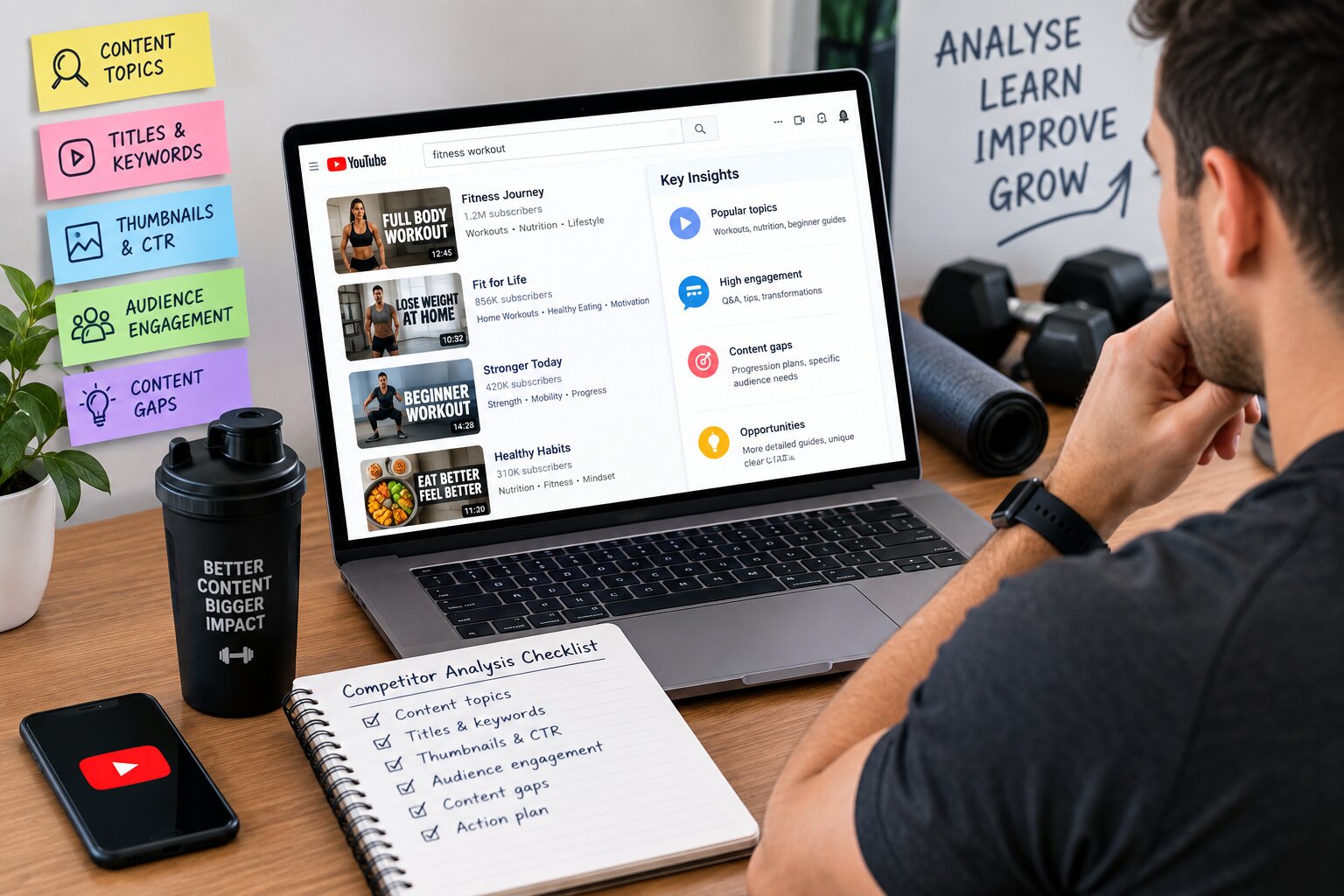
You’re uploading videos consistently, but the Analyze Competitors fitness channel seems to be getting more attention from the same type of audience.
Before assuming they simply have better luck, take a closer look at what they’re doing.
A proper YouTube Competitor Analysis can show you which topics competitors are covering, what their audience responds to, how they position their expertise and—perhaps most importantly—where they are leaving opportunities on the table.
The point isn’t to copy another fitness creator. It’s to understand the market well enough to make smarter decisions for your own channel.
What Is YouTube Competitor Analysis?
YouTube Competitor Analysis is the process of studying relevant competing channels and videos to understand their content, positioning, audience and performance patterns.
For a fitness business, you might examine:
- Video topics and formats
- Titles and search intent
- Thumbnails
- Audience engagement
- Content consistency
- Calls to action
- Channel positioning
- Content gaps
The key word here is relevant.
A personal trainer doesn’t necessarily need to analyse the biggest fitness channel on YouTube. A smaller channel attracting the same type of clients may provide much more useful information.
How to Find Your Real Fitness YouTube Competitors
Start with the audience you want to attract.
Imagine you run an online fitness coaching business for beginners who want to lose weight. Search YouTube for topics your potential clients might actually look for, such as beginner workouts, home weight-loss workouts or sustainable weight-loss advice.
Pay attention to which channels repeatedly appear.
Then build a shortlist of around 5–10 relevant competitors.
You can also combine YouTube channel competitor research with find high-intent YouTube keywords . This helps you discover not only who your competitors are, but also what your potential clients are searching for.
What Should You Analyse on a Competitor YouTube Channel?
-
Look at Their Content Topics
Don’t just look at their most-viewed video.
Look for patterns.
Are they repeatedly creating beginner workouts? Do educational videos perform well? Are they focusing on nutrition, strength training, mobility or transformations?
For example, if you’re a personal trainer and several competing channels consistently create videos answering beginner questions, that tells you something about the audience’s interests.
Your job is to identify patterns you can learn from—not copy.
-
Study Their Titles
Titles can reveal how a competitor is targeting a particular viewer.
Compare:
“Leg Workout”
with:
“15-Minute Leg Workout for Beginners at Home”
The second title gives the viewer much more information about who the video is for and what they will get.
During your Fitness YouTube competitor analysis, look for the relationship between the topic, audience and search intent.
Then ask yourself: Could I address the same problem more clearly or from a different angle?
-
Analyse Their Thumbnails
A thumbnail doesn’t need to be complicated to be effective.
Look at competing channels and ask:
- Is the main subject obvious?
- Is the text easy to understand?
- Does the thumbnail communicate the video’s topic?
- Is the design consistent with the brand?
- Does it look different from the surrounding search results?
If your videos receive impressions but struggle to earn clicks, competitor research can help you identify patterns worth testing alongside improving your fitness YouTube channel.
-
Read the Comments
This is one of the most overlooked parts of YouTube audience analysis.
Comments can tell you what viewers are confused about, what they want next and what problems they are trying to solve.
Suppose viewers repeatedly ask a competitor:
“Can I do this workout if I have never trained before?”
That question could become an entire video.
You’re no longer guessing what your audience wants. You’re using real conversations to generate content ideas.
-
Find the Gaps
This is where Competitor analysis for YouTube channels becomes genuinely useful.
Maybe competitors cover the same popular topics but explain them at a very basic level. Maybe they answer workout questions but rarely discuss how to progress. Or perhaps they attract viewers but don’t give them a clear next step.
Those gaps can become opportunities.
For example:
Competitor approach:
“20-Minute Full Body Workout”
Your opportunity:
“20-Minute Full Body Workout for Beginners + How to Progress for 4 Weeks”
The goal isn’t necessarily to make a longer video. It’s to make the content more useful for a specific viewer.
Turn Research Into Your Own Content Strategy
Don’t finish your research with a spreadsheet full of competitor data.
Turn what you discovered into decisions.
For each opportunity, ask:
What are competitors doing well?
Understand the pattern.
What are they missing?
Look for unanswered questions.
What can I explain differently?
Use your own experience and expertise.
Does this support my business?
Connect suitable content with your coaching, training, membership or other offer.
This is where competitor research should feed directly into your YouTube content strategy.
If you’re building a larger content plan, you can also benchmark your fitness YouTube channel to compare your own channel against the patterns you’ve discovered.
Common YouTube Competitor Analysis Mistakes
Competitor research can become a waste of time if you approach it incorrectly.
Avoid:
- Choosing competitors only because they have more subscribers
- Copying their titles word-for-word
- Focusing only on view counts
- Ignoring their audience comments
- Studying just one competitor
- Collecting data without taking action
- Assuming another channel’s strategy will automatically work for your business
Your competitors can provide useful clues, but your own audience and analytics should ultimately guide your decisions.
How Often Should You Do Competitor Research?
You don’t need to check competitors every day.
A deeper review every few months can help you spot changes in topics, formats, positioning and audience interests. Smaller checks can be useful when you’re planning a new content series.
Most importantly, compare competitor insights with your own YouTube Analytics.
Your competitors can show you what is happening around you. Your own data shows you how your audience is responding to your content.
Conclusion
Good YouTube Competitor Analysis isn’t about finding a successful channel and copying it.
It’s about understanding what your target audience is watching, what questions remain unanswered and where your fitness business can provide something genuinely useful.
When you combine competitor research with keyword research, YouTube SEO, channel optimisation and analytics, you can make content decisions based on evidence rather than guesswork.
Frequently Asked Questions
-
How do I analyse fitness YouTube competitors?
Identify channels targeting a similar audience, then compare their content topics, titles, thumbnails, engagement, audience questions, positioning and content gaps.
-
How many YouTube competitors should I analyse?
Start with 5–10 relevant channels. Relevance is more important than subscriber count.
-
What should I analyse on a competitor YouTube channel?
Look at topics, titles, thumbnails, audience comments, engagement, content formats, publishing patterns, positioning and opportunities they may be missing.
-
Should I copy successful competitor videos?
No. Use competitors for research and inspiration, then create original content based on your expertise, audience and business goals.
-
Can competitor research help grow a fitness YouTube channel?
It can help you identify audience interests, content gaps and strategic opportunities. However, competitor research works best as part of a broader YouTube SEO and content strategy.
-
Should I only analyse larger fitness channels?
No. Smaller channels can be highly relevant if they attract the same audience or compete for the same topics and search intent.
Your competitors can give you useful information, but they shouldn’t become your blueprint. Study their content, understand their audience and identify the gaps. Then use those insights to create a YouTube strategy that fits your fitness business and the clients you actually want to attract.
If your fitness YouTube channel is getting views but those views aren’t translating into qualified enquiries, a competitor and channel audit can help uncover opportunities in content, search visibility, positioning, CTR, and conversion.